Publications
-
On K-moduli of quartic threefolds, with Hamid Abban, Ivan Cheltsov, Yuchen Liu, and Andrea Petracci.
[arXiv]
To appear in Algebraic Geometry.
-
The Rapid Rise of Generative AI: Assessing risks to safety and security, with Ardi Janjeva, Alexander Harris, Sarah Mercer, and Anna Gausen.
[link]
Centre for Emerging Technology and Security (CETaS) Research Report, 2023.
-
Machine learning detects terminal singularities, with Tom Coates and Sara Veneziale.
[link/arXiv]
Neural Information Processing Systems (NeurIPS), 2023.
(Supporting data.)
-
Machine learning the dimension of a Fano variety, with Tom Coates and Sara Veneziale.
[doi/arXiv]
Nature Communications, 14 (2023), 5526.
(Supporting data: weighted projective space, toric Picard rank 2.)
-
Polytopes and machine learning, with Jiakang Bao, Yang-Hui He, Edward Hirst, Johannes Hofscheier, and Suvajit Majumder.
[doi/arXiv]
International Journal of Data Science in the Mathematical Sciences, 1 (2023), no. 2, 181–211.
-
Toric Sarkisov links of toric Fano varieties, with Gavin Brown and Jarosław Buczyński.
[MR/doi/arXiv]
In "Birational Geometry, Kähler–Einstein Metrics and Degenerations", Springer, 2023, pp. 129-144.
-
Machine learning the dimension of a polytope, with Tom Coates and Johannes Hofscheier.
[MR/doi/arXiv]
In "Machine Learning in Pure Mathematics and Theoretical Physics", World Scientific, 2023, pp. 85-104.
(Supporting data: lattice polytopes, rational polytopes.)
-
Computation and data in the classification of Fano varieties, with Gavin Brown, Tom Coates, Alessio Corti, Tom Ducat, and Liana Heuberger.
[arXiv]
In "Nankai Symposium on Mathematical Dialogues", Springer, 2022.
-
On the maximum dual volume of a canonical Fano polytope, with Gabriele Balletti and Benjamin Nill.
[MR/doi/arXiv]
Forum of Mathematics, Sigma, 10 (2022), e109.
(Supporting data.)
-
On the Fine interior of three-dimensional canonical Fano polytopes, with Victor Batyrev and Karin Schaller.
[MR/doi/arXiv]
In "Interactions with Lattice Polytopes", Springer, 2022, pp. 11-47.
-
Laurent polynomials in mirror symmetry: why and how?, with Victor Przyjalkowski.
[MR/doi/arXiv]
Proyecciones J. Math., 41 (2022), no. 2, 481-515.
-
Databases of quantum periods for Fano manifolds, with Tom Coates.
[doi/arXiv]
Scientific Data, 9 (2022), 163.
(Supporting data: dimension 1, dimension 2, dimension 3, dimension 4.)
-
Gorenstein formats, canonical and Calabi-Yau threefolds, with Gavin Brown and Lei Zhu.
[MR/doi/arXiv]
Experimental Mathematics, 31 (2022), no. 1, 146-164.
-
Hilbert series, machine learning, and applications to physics, with Jiakang Bao, Yang-Hui He, Edward Hirst, Johannes Hofscheier, and Suvajit Majumder.
[MR/doi/arXiv]
Physics Letters B, 827, 136966 (2022).
-
Maximally mutable Laurent polynomials (appendix 2.3MB), with Tom Coates, Giuseppe Pitton, and Ketil Tveiten.
[MR/doi/arXiv]
Proceedings of the Royal Society Series A, 477: 20210584 (2021).
-
Quantum periods for certain four-dimensional Fano manifolds, with Tom Coates, Sergey Galkin, and Andrew Strangeway.
[MR/doi/arXiv]
Experimental Mathematics 29 (2020), no. 2, 183-221.
-
Laurent inversion, with Tom Coates and Thomas Prince.
[MR/doi/arXiv]
Pure and Applied Mathematics Quarterly, 15 (2019), no. 4, 1135-1179.
-
Appendix to Four dimensional Fano quiver flag zero loci, by Elana Kalashnikov. Appendix joint with Tom Coates and Elana Kalashnikov.
[MR/doi/arXiv]
Proceedings of the Royal Society Series A, 475:20180791 (2019).
-
Ehrhart polynomial roots of reflexive polytopes, with Gábor Hegedüs and Akihiro Higashitani.
[MR/doi/arXiv]
Electronic Journal of Combinatorics, 26 (2019), no. 1, P1.38.
-
Fano 3-folds in P2 x P2 format, Tom and Jerry, with Gavin Brown and Muhammad Imran Qureshi.
[MR/doi/arXiv]
European Journal of Mathematics, 4 (2018), no. 1, 51-72.
-
Minimality and mutation-equivalence of polygons, with Benjamin Nill and Thomas Prince.
[MR/doi/arXiv]
Forum of Mathematics, Sigma, 5 (2017), e18.
-
Mutations of fake weighted projective planes, with Mohammad Akhtar.
[MR/doi/arXiv]
Proceedings of the Edinburgh Mathematical Society, 59 (2016), no. 2, 271-285.
-
Quantum periods for 3-dimensional Fano manifolds, with Tom Coates, Alessio Corti, and Sergey Galkin.
[MR/doi/arXiv]
Geometry & Topology, 20-1 (2016), 103-256.
-
Mirror symmetry and the classification of orbifold del Pezzo surfaces, with Mohammad Akhtar, Tom Coates, Alessio Corti, Liana Heuberger, Alessandro Oneto, Andrea Petracci, Thomas Prince, and Ketil Tveiten.
[MR/doi/arXiv]
Proceedings of the American Mathematical Society, 144 (2016), 513-527.
-
Four-dimensional projective orbifold hypersurfaces, with Gavin Brown.
[MR/doi/arXiv]
Experimental Mathematics, 25 (2016), no. 2, 176-193.
-
Four-dimensional Fano toric complete intersections, with Tom Coates and Thomas Prince.
[MR/doi/arXiv]
Proceedings of the Royal Society Series A, 471:20140704 (2015).
-
Mutations of fake weighted projective spaces, with Tom Coates, Samuel Gonshaw, and Navid Nabijou.
[MR/doi/arXiv]
Electronic Journal of Combinatorics, 21 (2014), no. 4, P4.14.
-
Seven new champion linear codes, with Gavin Brown.
[MR/doi/arXiv]
LMS Journal of Computation and Mathematics, 16 (2013), 109-117.
-
Mirror symmetry and Fano manifolds, with Tom Coates, Alessio Corti, Sergey Galkin, and Vasily Golyshev.
[MR/doi/arXiv]
In "Proceedings of the 6th European Congress of Mathematics", European Mathematical Society, 2013, pp. 285-300.
-
Small polygons and toric codes, with Gavin Brown.
[MR/doi/arXiv]
Journal of Symbolic Computation, 51 (2013), 55-62.
-
Minkowski polynomials and mutations (appendices 6.5MB), with Mohammad Akhtar, Tom Coates, and Sergey Galkin.
[MR/doi/arXiv]
SIGMA, 8 (2012), 094, pp. 707.
-
Fano polytopes, with Benjamin Nill.
[MR/doi]
In "Strings, Gauge Fields, and the Geometry Behind - the Legacy of Maximilian Kreuzer", World Scientific, 2012, pp. 349-364.
-
Reflexive polytopes of higher index and the number 12, with Benjamin Nill.
[MR/doi/arXiv]
Electronic Journal of Combinatorics, 19 (2012), no. 3, P9.
-
The boundary volume of a lattice polytope, with Gábor Hegedüs.
[MR/doi/arXiv]
Bulletin of the Australian Mathematical Society, 85 (2012), 84-104.
-
Roots of Ehrhart polynomials of smooth Fano polytopes, with Gábor Hegedüs.
[MR/doi/arXiv]
Discrete and Computational Geometry, 46 (2011), no. 3, 488-499.
-
Canonical toric Fano threefolds.
[MR/doi/arXiv]
Canadian Journal of Mathematics, 62 (2010), no. 6, 1293-1309.
(Supporting data.)
-
On the combinatorial classification of toric log del Pezzo surfaces, with Maximilian Kreuzer and Benjamin Nill.
[MR/doi/arXiv]
LMS Journal of Computation and Mathematics, 13 (2010), 33-46.
-
Bounds on fake weighted projective space.
[MR/doi/arXiv]
Kodai Mathematical Journal, 32 (2009), 197-208.
-
A note on palindromic δ-vectors for certain rational polytopes, with Matt Fiset.
[MR/doi/arXiv]
Electronic Journal of Combinatorics, 15 (2008), N18.
-
Toric Fano threefolds with terminal singularities.
[MR/doi/arXiv]
Tohoku Mathematical Journal, 58 (2006), no. 1, 101-121.
-
Toric Fano varieties and convex polytopes.
[MR/link]
PhD Thesis, 2006, University of Bath. My supervisor was Professor G K Sankaran.
Preprints
-
Mirror symmetry, Laurent inversion and the classification of Q-Fano threefolds, with Tom Coates and Liana Heuberger.
[arXiv]
-
Kawamata boundedness for Fano threefolds and the Graded Ring Database, with Gavin Brown.
[arXiv]
(Supporting data.)
-
Sharp bounds on fake weighted projective spaces with canonical singularities, with Gennadiy Averkov, Martin Lehmann, and Benjamin Nill.
[arXiv]
-
Projecting Fanos in the mirror, with Ludmil Katzarkov, Victor Przyjalkowski, and Dmitrijs Sakovics.
[arXiv]
-
Quasi-period collapse for duals to Fano polygons: an explanation arising from algebraic geometry, with Ben Wormleighton.
[arXiv]
-
Equivalence classes for smooth Fano polytopes, with Akihiro Higashitani.
-
Three-dimensional lattice polytopes with two interior lattice points, with Gabriele Balletti.
[arXiv]
-
Singularity content, with Mohammad Akhtar.
[arXiv]
-
Classifying terminal weighted projective space.
[arXiv]
-
Normal forms of convex lattice polytopes, with Roland Grinis.
[arXiv]
-
Computational birational geometry of minimal rational surfaces, with Gavin Brown and Daniel Ryder.
[arXiv]
Edited volumes
-
Recent Developments in Algebraic Geometry, Hamid Abban, Gavin Brown, Alexander Kasprzyk, and Shigefumi Mori (eds), London Mathematical Society Lecture Note Series, 478, Cambridge University Press, 2022.
-
Interactions with Lattice Polytopes, Alexander Kasprzyk and Benjamin Nill (eds), Springer Proceedings in Mathematics & Statistics, 386, Springer, 2022.
Datasets
-
Ehrhart series coefficients and quasi-period for random rational polytopes, with Tom Coates and Johannes Hofscheier.
A dataset of Ehrhart data for 84000 randomly generated rational polytopes, in dimensions 2 to 4, with quasi-periods 2 to 15.
-
Ehrhart series coefficients for random lattice polytopes, with Tom Coates and Johannes Hofscheier.
A dataset of Ehrhart data for 2918 randomly generated lattice polytopes, in dimensions 2 to 8.
-
A dataset of 150000 terminal weighted projective spaces, with Tom Coates and Sara Veneziale.
A dataset of 150000 randomly generated weighted projective spaces with at worst terminal singularities, in dimensions 1 to 10.
-
A dataset of 200000 terminal toric varieties of Picard rank 2, with Tom Coates and Sara Veneziale.
A dataset of 200000 randomly generated Fano toric varieties of Picard rank 2 with at worst terminal Q-factorial singularities, in dimensions 2 to 10.
-
Certain rigid maximally mutable Laurent polynomials in three variables, with Tom Coates and Giuseppe Pitton.
This dataset contains certain rigid maximally mutable Laurent polynomials (rigid MMLPs) in three variables.
-
Regularized quantum periods for four-dimensional Fano manifolds, with Tom Coates.
This is a database of regularized quantum periods for four-dimensional Fano manifolds. The database will be updated as new four-dimensional Fano manifolds are discovered and new regularized quantum periods computed.
-
Regularized quantum periods for three-dimensional Fano manifolds, with Tom Coates.
This is a database of regularized quantum periods for three-dimensional Fano manifolds.
-
Regularized quantum periods for two-dimensional Fano manifolds, with Tom Coates.
This is a database of regularized quantum periods for two-dimensional Fano manifolds.
-
Regularized quantum periods for one-dimensional Fano manifolds, with Tom Coates.
This is a database of regularized quantum periods for one-dimensional Fano manifolds.
-
The classification of toric canonical Fano 3-folds.
This dataset describes the classification of all toric canonical Fano 3-folds. Equivalently, it describes the classification of all 3-dimensional convex lattice polytopes with exactly one interior lattice point.
-
The Fano 3-fold database, with Gavin Brown.
This is a dataset that relates to the graded (homogeneous coordinate) rings of possible algebraic varieties: complex Fano 3-folds with Fano index 1.
Electronic resources
-
The Graded Ring Database, with Gavin Brown.
An online database of graded rings in algebraic geometry, including classifications of toric varieties, polarised K3 surfaces, and Fano 3-folds and 4-folds.
-
PCAS: A Parallel Computational Algebra System, with Tom Coates.
PCAS is a suite of microservices that enable data-fluent, massively parallel computational algebra calculations.
-
Fano varieties and extremal Laurent polynomials, with Tom Coates, Alessio Corti, Sergey Galkin, and Vasily Golyshev.
A collaborative research blog on the topic of Fano varieties, extremal Laurent polynomials, and mirror symmetry.
-
Convex polytopes and polyhedra, with Gavin Brown and Jarosław Buczyński.
A Magma computational algebra package for working with convex polytopes and polyhedra.
-
Toric varieties, with Gavin Brown and Jarosław Buczyński.
A Magma computational algebra package for working with toric varieties.
In the press
-
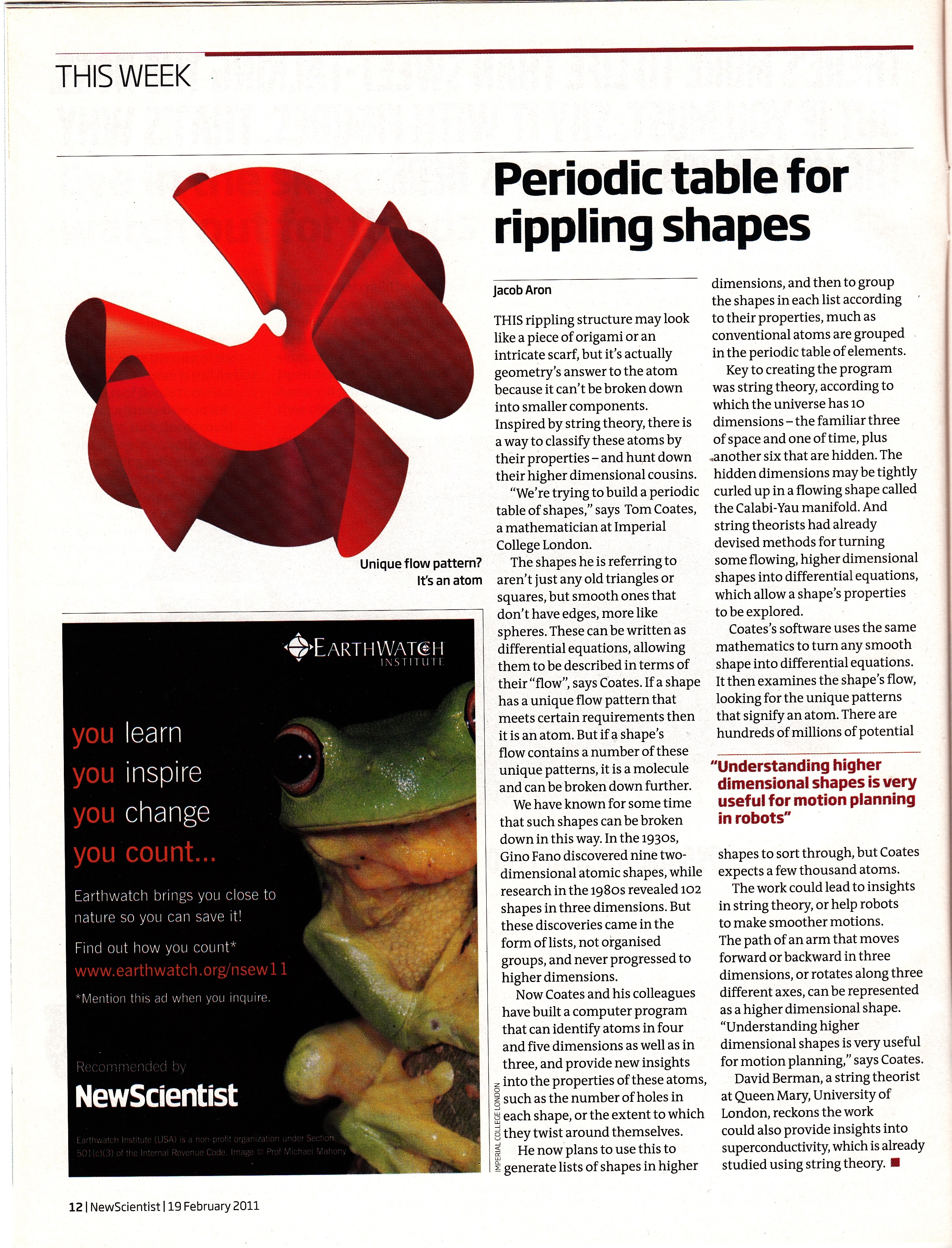
New Scientist: AI is helping mathematicians build a periodic table of shapes
"Mathematicians attempting to build a 'periodic table' of shapes have turned to artificial intelligence for help – but say they don’t understand how it works or whether it can be 100 per cent reliable..."
-
Popular Mechanics: Mathematicians are close to building the perfect periodic table of shapes
"Just as molecules can be broken down into atoms, so too can mathematical shapes be broken down into more basic components..."
-
Math in the Media: A monthly magazine from the AMS
"Beautiful pictures and animations reminiscent of flowers or folding cloth grace recent posts of this blog, in which most entries take the form of a technical conversation between specialists Tom Coates, Alessio Corti, Sergei Galkin, Vasily Golyshev, and Al Kasprzyk..."
-
Physics World: Nature's building blocks brought to life
"The scientists are looking for shapes, known as "Fano varieties", which are basic building blocks and cannot be broken down into simpler shapes. They find Fano varieties by looking for solutions to a variety of string theory, a theory that seeks to unify quantum mechanics with gravity..."
-
Science: Elementary mathematics
"An international group of mathematicians hopes to do for math what Dmitri Mendeleev’s periodic table did for chemistry by identifying the shapes in three, four, and five dimensions that cannot be divided into other shapes..."
-
New Scientist: Atoms ripple in the periodic table of shapes
"This rippling structure may look like a piece of origami, or an intricate scarf. In fact, it is geometry's answer to the atom because it can't be broken down into smaller components. Inspired by string theory, there is now a way to classify these atoms by their properties – and hunt down their higher dimensional cousins..."
-
Cosmos: Mathematicians propose periodic table of shapes
"Mathematicians have embarked on a three-year project to create their own version of the periodic table that will provide a vast directory of all the possible shapes in the universe across three, four and five dimensions..."
-
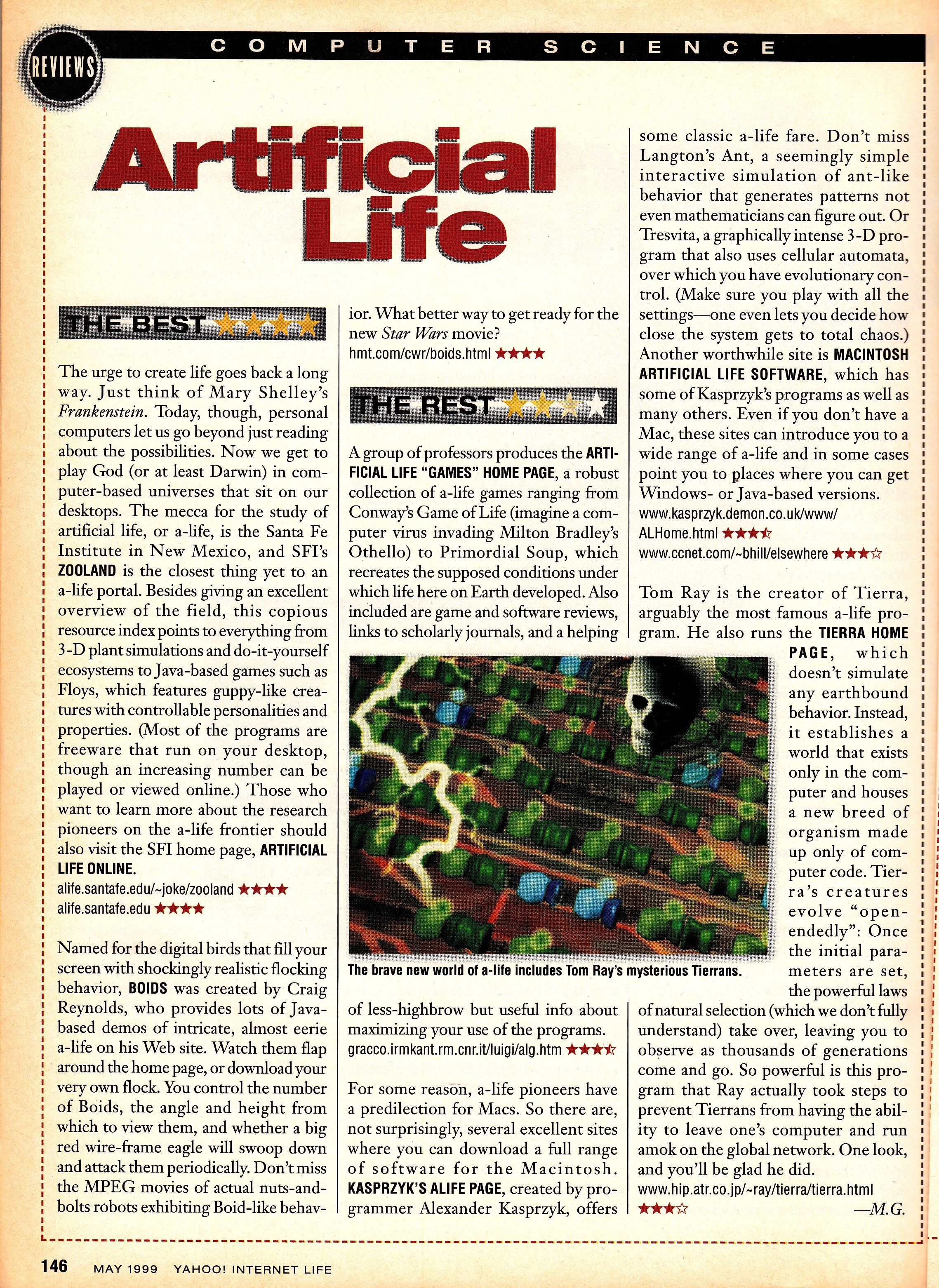
Yahoo!: Artificial life
"The urge to create life goes back a long way. Just think of Mary Shelley's Frankenstein. Today, though, personal computers let us go beyond just reading about the possibilities. Now we get to play God..."
-
MacFormat: It's alive!
"Artificial life – or 'A-life' – is a relalively new branch of science that melds the highest levels of computing and biology. For some programmers, the goal is to come up with a superior form of AI by building software models of the smartest computer currently known, the brain, and seeing if those models can learn and adapt their behaviour as we can...."